Meet the team
By Miguel Cunha ·
Hi everyone.
Yes, I know: there was no newsletter last week. I didn't forget. We had so many meetings that the email I wrote most was "be there in 5 minutes".
In the first email I sent you, I promised to tell you how we run Waldyn as an AI-native company. It took me a while, because it's genuinely hard to map out how we're doing this today. So instead of showing you processes, I'm going to introduce you to the team.
Our team is still small. But we have a few colleagues who don't take holidays, don't drink coffee, and one of them has a real talent for getting on our nerves.
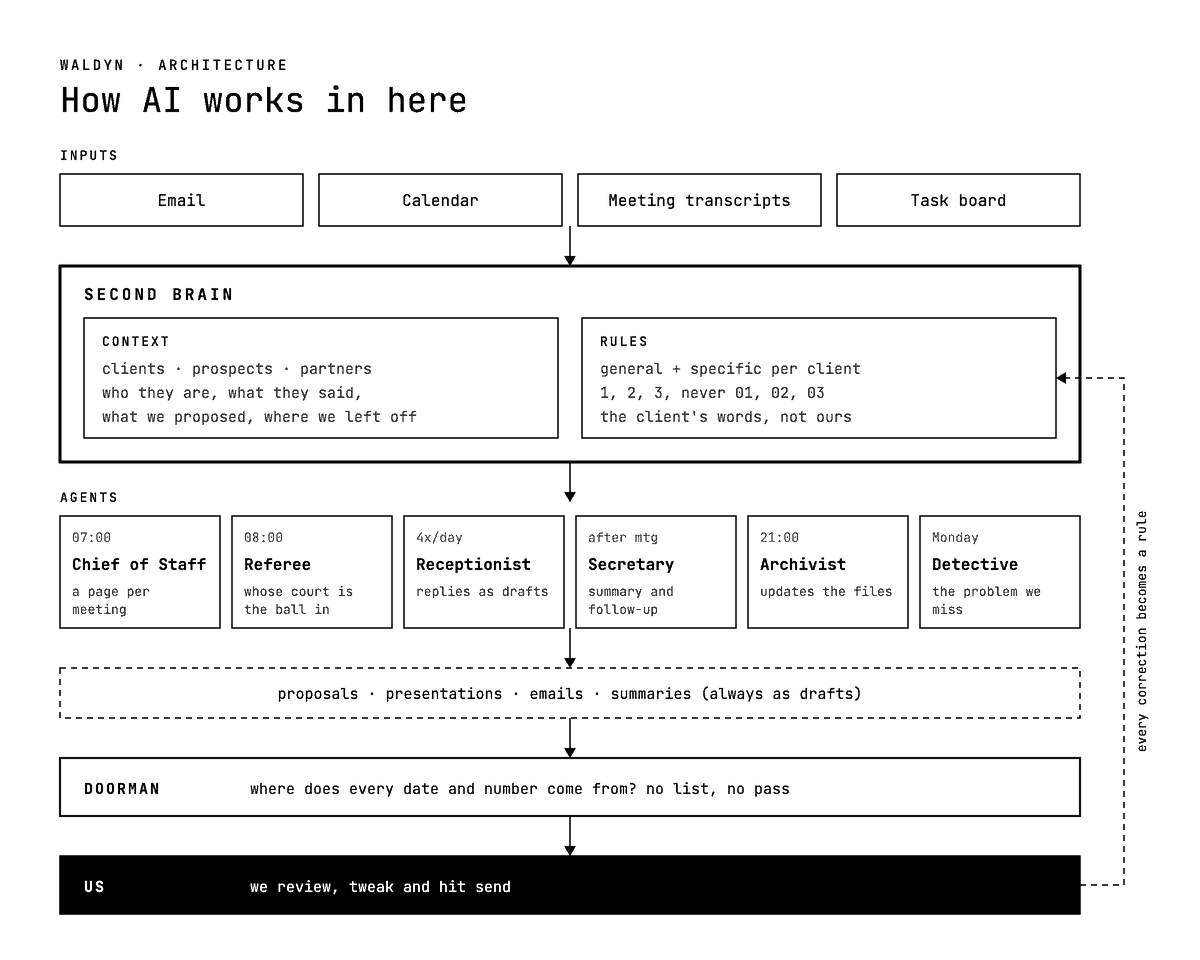
Every day at 7am, the Chief of Staff leaves a page in my inbox for every meeting of the day: who the company is, how much it bills, what we talked about last time, what each side promised, and the questions we haven't asked yet. I never walk into a meeting thinking "where were we?" anymore.
At 8am in comes the Referee, the annoying one. It looks at every client conversation and tells us whose court the ball is in: it checks who sent the last email and, if we're the ones who went quiet, it blows the whistle. No "I thought I'd already replied" survives the Referee.
Four times a day, the Receptionist goes through the emails we've received. When it can, it leaves the reply ready as a draft. When a decision from us is needed, it flags it. It never sends anything. It has strict orders not to.
After every meeting, the Secretary takes the transcript, writes the summary, moves the tasks to our board and gets the follow-up email ready. We just review it and hit send.
Every night at 9pm, the Archivist goes through every conversation of the day and updates each client's file: where we are, what changed, who the new person in cc is. It's the most boring colleague and the most important one.
On Mondays, the Detective reads the whole previous week, emails, meetings and proposals, looking for one thing: the problem we're not seeing. Sometimes it's uncomfortably right.
These colleagues are a huge help. But none of them would work without our second brain, which they all read before doing anything.
The second brain holds all the context on every client, prospect and partner we've ever spoken to: who they are, what they told us, what we proposed and where we left off. And on top of that context, it has rules, some general and some specific to each of them.
The rules are the most interesting part. Every time we correct the AI, the correction becomes a rule, and the next result already comes out our way. Things like:
- 1, 2, 3. Never 01, 02, 03.
- Use the client's words, never ours.
- Never write "as agreed" about something we only agreed internally.
And to make sure that last one never slips, we have a seventh colleague, the Doorman: no draft goes out without a list of where every date and every number comes from. No list, no door.
The result is that when I ask "get the proposal ready for company X", I don't have to explain anything. It already knows what the company does, what they told us and what's still open. There are still tweaks, of course, but a proposal or a presentation now takes us about 20% of the time it used to.
Here's the org chart, for those who like things drawn out:
There's one thing none of these colleagues does: build relationships. And that's no accident. All of this automation only exists because it gives us time for what matters most: getting to know the people we work with better, and understanding what our clients actually need.
Talk soon,
Miguel